Poly relationships (or polyamorous relationships) involve openly loving more than one person at a time. Polyamory, often shortened to “poly,” means having multiple romantic (and often sexual) relationships concurrently with the informed consent of everyone involved.
Unlike monogamy or casual dating, polyamory emphasizes emotional connections and honesty. A key principle is that love is not a limited resource – you can share it without “running out”. In practice, people in poly relationships negotiate rules and boundaries together, and often celebrate diversity in how they structure their relationships.
Communication and consent are essential. For example, experts note that polyamorous relationships rely on open honesty: partners fully disclose their status and agree to the arrangement.

This distinguishes polyamory from infidelity: all parties know about and accept the multiple partnerships. In fact, polyamory explicitly “is not…bigamy or polygamy,” which involve legally marrying multiple spouses and are illegal in most places.
Instead, polyamory is voluntary and involves ongoing consent. Research finds that polyamory often parallels monogamy in relationship quality – studies report similar levels of well-being for people in consensually non-monogamous relationships compared to monogamous ones.
Public awareness is growing: one review suggests over 20% of Americans have participated in consensual non-monogamous relationships at some point.
Polyamory vs. Monogamy, Open Relationships, and Polygamy
It helps to clarify terms. A poly relationship usually means any romantic/sexual relationship that is part of a polyamorous network. Polyamory is the overall philosophy or practice. People sometimes ask, “Is a poly relationship the same as polyamory?” In effect, yes: a poly relationship is a polyamorous relationship.
In contrast, a monogamous relationship involves only two partners. Polyamory also differs from a typical open relationship: an open relationship might allow sex outside the couple, but polyamory involves emotional intimacy and multiple committed bonds.
One guide emphasizes that polyamory involves emotional and romantic intimacy with multiple partners, and everything is disclosed and agreed upon by everyone.
It is also distinct from polygamy/bigamy. Polygamy is legally marrying more than one spouse (typically one man with multiple wives). By law, this is illegal in most Western countries.
Polyamory explicitly rejects coercion and aims for equal respect among partners. As one expert notes, successful poly relationships treat additional partners as adding to love rather than taking it away. In practice, people in healthy poly networks often say they aren’t seeking more sex, but rather more love and connection.
That sentiment is captured by the idea that “love isn’t limited; the heart grows with each connection.” In fact, poly advocates often quote sayings like “love is infinite; time is finite,” highlighting that multiple partnerships can flourish if time and care are balanced.
Setting Rules and Boundaries
In any poly arrangement, clear guidelines help prevent misunderstandings. Many poly people prefer the term agreements over rigid “rules.” Advice from poly veterans emphasizes simple principles.

For example, a well-known poly blog urges partners to “treat others with respect,” avoid imposing your will on others, and focus on your own feelings instead of trying to control someone else.
In other words, effective “rules” tend to be personal behavior guidelines rather than demands on others. Couples might make agreements about communication (e.g. how much detail to share about other dates) or conduct (e.g. always use protection).
A counseling guide notes that establishing boundaries and expectations is a big part of polyamory. This can include agreements on when and whether to disclose details, how to divide time among partners, what sexual activities are acceptable, and safety practices. Anything that would normally be “cheating” must be clearly defined (for example, lying about a date is usually considered cheating in polyamory).
-
Example Guidelines: Many couples write down their “ground rules” or have regular check-ins. Common topics are: scheduling visits, sexual safety (e.g. condom use or testing), disclosure to family/friends, and how to handle emotional triggers like jealousy.
-
The emphasis is on ongoing communication. One polyamorous coach advises taking feelings of jealousy as signals to discuss underlying needs. Another tip from experienced poly daters is to always disclose your non-monogamous status up front (e.g. mention it on dating profiles).
Types of Poly Relationships
Polyamory comes in many forms. Unlike monogamy’s single model, poly relationships can be structured in various ways depending on personal preference. Here are some common arrangements:
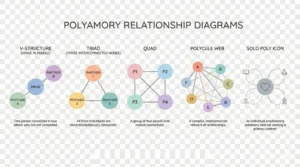
- Triad (Throuple): Three people are all involved together. A triad can be a closed group (all three intimately connected) or a “V” shape (see below). In a fully connected triad, everyone dates everyone, creating a three-way relationship.
- Vee: One person dates two others who are not partners with each other. The person at the point of the V is sometimes called the “hinge” or “anchor,” and the other two are their partners but not involved with one another.
- Quad: Four people where relationships branch out. Often this happens when two couples form connections with each other. A “full quad” would mean all four are romantically involved in some way.
- Polycule: Any network of people connected through poly relationships. For example, Person A and B are primary partners; A also dates C, and C dates D (who is also B’s friend). This forms a chain or web called a polycule. A polycule can look like a family tree of partners.
- Kitchen-Table Polyamory: A close-knit style where partners and metamours (“partner’s partners”) all interact like family. The term comes from the idea that everyone feels comfortable hanging out around the same kitchen table. Partners share daily life (meals, even child-rearing) together in one group.
- Parallel Polyamory: Relationships run in “parallel” without much crossover. Partners know about each other and support each other’s choices, but may never meet or interact much. They co-exist but have separate lives.
- Solo Polyamory: An individual maintains multiple relationships but resists traditional coupling. They typically do not want to merge households, finances, or titles with any partner. A solo poly person may value high autonomy and keep each relationship distinct.
- Relationship Anarchy: A more fluid philosophy than a specific structure. Relationship anarchists reject predefined rules and hierarchies. They form connections based purely on personal needs, without labeling things as “primary” or “secondary”. Every partnership (romantic, friendship, etc.) is negotiated freely without default expectations.
These categories often overlap, and people may evolve from one style to another. Poly relationships are highly customizable. As one poly guide notes, the goal is not to force a relationship into a rigid model but to find what works for the people involved.
Dating in a Poly Context
Dating as a polyamorous person brings its own etiquette. First and foremost: be upfront. People advise always stating your non-monogamous status on dating profiles. Trying to hide it only creates confusion and hurt later. If you’re new to poly or just exploring it, a common tip is to use community resources (like meetup groups or forums) to learn more before jumping in.
If you and a partner are opening up your relationship, many suggest dating one-on-one rather than only seeking a multi-person group from the start.
One experienced polyamory coach explains that when couples only look for another person together, it can unintentionally create a “unicorn hunter” dynamic or power imbalance.
Instead, partners are encouraged to date independently at first, to confront personal insecurities and learn to enjoy each other’s solo dating successes. This helps make each partner more confident, and later the couple can integrate new partners more sustainably.
For finding poly-friendly dates, there are dating apps tailored to non-monogamy. Popular choices include:
- Feeld: A widely-recommended app specifically for ethical non-monogamy. It connects people with alternative relationship models and allows profiles with multiple partners. Feeld users are often openly non-monogamous, kinky, or queer. It even has features like linking multiple people’s profiles (“Constellation” feature) for poly networks.
- Lex: A community app (not exclusively a dating app) catering to queer people. Many poly and non-monogamous individuals use Lex to post about events or personal ads. It functions as a text-based community board with polyamory groups and meetups.
- #open: An app built for open/ethical non-monogamous dating. It uniquely lets couples create linked profiles (solo and partnered modes), and uses hashtag-based interests to match people. (#open is explicitly for poly/open dating and even offers two profiles per account: one as a single user and one as a couple).
- OkCupid & Bumble: Mainstream apps have also added poly-friendly options. OkCupid has a setting for “non-monogamous” and will match you only with others who are open to it. Bumble now allows you to state “ethical non-monogamy” as a relationship intent. (Similarly, other apps like Grindr or Tinder allow listing polyamory in your profile). This means you don’t strictly need a special app; many people use mainstream apps with a clear disclosure.
Each app has pros and cons (availability varies by country and community size), but together they mean poly individuals have more ways to meet like-minded partners.
The poly community also heavily relies on forums (like Reddit’s r/polyamory) for support and advice, although official sources are limited. Online, polyamorous daters remind each other to go slow and maintain open communication with all partners during the dating process.
Inspirational Poly Relationship Quotes
People in polyamory often share quotes that capture their values. Here are some perspectives:
- Elisabeth Sheff (sociologist): “Polyam relationships offer more love – loving others without taking away from the love already established.” This highlights the idea that adding new relationships can expand rather than dilute love.
- Willow Smith (artist): “With polyamory, I feel like the main foundation is the freedom to be able to create a relationship style that works for you.” In other words, polyamory is valued for the creative freedom it offers in designing personal relationships.
- Tana Mongeau (public figure): “If being with multiple people makes me happy, then why not?”This bluntly captures the core of polyamory’s ethics: if a consenting arrangement brings happiness, it shouldn’t be shamed.
- Eve Rickert (author/educator): “Practicing ethical non-monogamy is about continually turning towards your partners — it’s action, not identity.” This emphasizes that polyamory is about behaviors (communication, respect) rather than just a label.
These and other quotes in the community underscore polyamory’s focus on honesty, respect, and mutual growth. Many sayings reflect the belief in boundless love: for example, “Love isn’t limited.
The heart grows with each connection,” and the common adage “Love is infinite; only time is finite.” They remind poly folks that managing time (finite) is the real challenge, since affection and caring are not inherently scarce.
Polyamorous Marriage and Legal Status
The idea of a “polyamorous marriage” raises many legal and practical questions. In most places, no legal framework exists for more-than-two-person marriages. For instance, in the United States every state defines marriage as between two people; there is no state that permits polyamorous marriage.
In fact, one poly law firm bluntly states, “As of today, there are a total of 0 states that recognize any marriage between more than two people.”. Domestic partnership ordinances in a few cities (like Somerville and Cambridge, MA) now allow polyamorous families to register for limited benefits, but these are not full marriages.
Worldwide, legal acceptance is similarly limited. Some countries allow traditional polygamy (again, usually one man with multiple wives) under religious law, but this is not the same as polyamory.
For example, South Africa’s laws recognize certain forms of polygamy for men, and many Middle Eastern countries legally permit men to marry multiple wives under Islam. However, equal three-way or triad marriages (where all partners are on the same footing) are not acknowledged by any government.
A recent legal guide confirms: “Polyamorous marriages are not currently recognized anywhere.”. That means you cannot obtain an official marriage license or certificate that lists more than two spouses.
In practice, some polyamorous people hold symbolic wedding ceremonies and even buy novelty “poly marriage certificates” for themselves. These have no legal power but serve as personal mementos. For legal protection, poly families often must use creative solutions.
Attorneys have described setting up an LLC (a business entity) owned equally by all partners to manage shared finances and property. More directly, specialized contracts called Polyamorous Relationship Agreements can be drafted.
One law firm reports writing a three-party contract that functions much like a prenuptial agreement for poly couples: it grants rights (inheritance, decision-making, etc.) as if the partners were married. Such agreements are fully customizable – for example, they can specify who has parental rights for children, or which assets belong to which subset of partners. Because these are contracts (not marriages), they are legally enforceable for all signers.
Key Point: Currently, no jurisdiction issues a legal three-person marriage certificate. If you are in a poly household with kids, you can sometimes achieve limited recognition through domestic partnership laws in a few locales (e.g. Somerville/Cambridge, MA) or through multi-parent adoption agreements.
But the bottom line is that outside very narrow exceptions, poly families lack the automatic protections marriage provides two spouses. This remains a contentious issue in the poly community, and advocates continue to push for legal reforms.
Pros and Cons of Polyamorous Relationships and Marriages
Like any relationship style, polyamory has benefits and challenges. Many people report positive outcomes: the expanded love and support network are chief among them. With multiple loving partners, you often have a built-in support system.
As one polyamorous writer notes, “Combining incomes and extra help with household chores and raising kids can make life much easier for everyone”. If one partner is busy or ill, others can step in with emotional support or practical help.
Polyamorists also speak of personal growth: polyamory often forces people to confront insecurities and communicate deeply, which can build confidence and empathy (Poly “keeps me on my toes,” one person writes).
The idea that love is abundant – “like solar energy” – allows some to love more people more fully than they thought possible. Many feel a sense of liberation from strict monogamous norms, experiencing a profound sense of freedom and acceptance.
However, there are genuine drawbacks. Jealousy and insecurity are often the first hurdles. Even poly people are not immune to jealousy, and having multiple partners simply creates more opportunities for it.
New polyamorists may feel shock or repulsion when confronted with a partner’s intimacy with someone else. Such feelings are natural and must be worked through with communication. Another major challenge is time and energy.
As one writer metaphorically warns, balancing the lives and needs of three or more partners “can feel like a Cirque du Soleil act”. Scheduling dates, maintaining multiple households or beds, and juggling everyone’s emotional needs can be exhausting. There’s also more potential for conflict: if one partner falls in love faster or changes preferences, it complicates the group dynamic.
Health risks are a practical concern: with more sexual partners (and their other partners), the chance of sexually transmitted infections rises. This means stricter safer-sex habits are critica. Social stigma is another issue – unfortunately, polyamorous people still often face misunderstanding or ostracism from family, employers, or society at large. Onlookers may invalidate poly relationships or exclude polyamorous partners from events.
To summarize pros and cons more concretely:
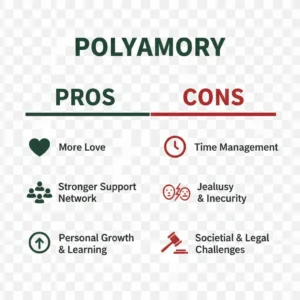
- Pros: More love and support (multiple caregivers, confidants, etc.), personal growth and communication skills, flexibility to meet diverse needs, a sense of freedom and authenticity. In poly “families,” chores, bills, and childcare can be shared among several adults. Many poly people report feeling more loved overall than in any past monogamous relationship.
- Cons: Greater potential for jealousy and comparison, logistical complexity (scheduling, conflict resolution), health considerations (STI risk), social/legal insecurity, and a smaller pool of willing partners. People in smaller communities or with conservative social circles may find it very hard to date as poly, effectively reducing their dating pool. Also, polyarrangements can be more expensive (e.g. multiple rents, flights to visit different partners).
Every relationship style has trade-offs. Polyamory works best for those who relish open communication and can navigate complexity. Quotes from the community often remind us, “Polyamory is clearly not for everyone, but then again neither is monogamy.”. As with any path, individuals must weigh these pros and cons.
Poly Relationships Today – Discussion and Community
Although polyamory remains a minority lifestyle, awareness is growing. Online forums, books, and therapists now exist for guidance. For example, Reddit’s r/polyamory is a popular forum where thousands share experiences, ask questions, and find solidarity (no academic citation for Reddit, but it’s a lively community resource).
Researchers and articles in popular media also cover polyamory; a current Verywell Mind guide (2025) provides an overview of how poly relationships work and emphasizes consent and communication.
In practice, no two polyamorous relationships look exactly alike. Some may be quite private and only recognized within their circle, while others celebrate it openly and even hold ceremonies.
One polyamorous couple might eventually decide to have a legal marriage between two of them (as the “primary” spouses) and simply love the third partner outside of that marriage. Others feel comfortable doing life together as a trio without any legal paperwork.
What is clear is that intentionality matters. The healthiest poly relationships tend to be those where all members actively nurture honesty, set clear agreements, and support each other’s autonomy. As one resource advises: regularly check in with each partner about needs and boundaries, support metamours’ well-being, and practice empathy.
Key Takeaways
-
Definition: Polyamory means having multiple consensual romantic relationships. A “poly relationship” is simply one such relationship within that framework.
-
Agreements Over Rules: Poly partners usually create flexible agreements (e.g. safe-sex rules, time sharing) to ensure mutual respect.
-
Types: Poly networks take many forms (triads, quads, kitchens, parallel, solo, etc.. Choose what fits your needs.
-
Dating & Apps: Honesty is crucial. Use poly-friendly apps (Feeld, #open, etc.) or mainstream apps with non-monogamy filters. Explicitly state your polyamory to potential dates.
-
Jealousy & Emotions: Feeling jealous is normal; talk it through. Communities often talk about compersion – joy at seeing partners happy with others – as a positive emotion to cultivate.
-
Poly Marriage: No country currently legally recognizes three-person marriages. Some places allow limited poly family benefits (e.g. Somerville MA domestic partnerships). Couples usually use contracts or domestic partnership laws for protection, as the law has not caught up.
-
Legal Status: Polyamory is not polygamy. Polygamy laws (where they exist) generally favor one-man multi-wife unions, and polyamorous triads have no legal standing. You cannot get a legal “polyamory marriage certificate” in any jurisdiction currently.
-
Pros & Cons: Poly can offer rich love networks and personal growth, but it also involves more complex logistics, potential jealousy, health precautions, and social stigma.
In the end, polyamory is one of many valid ways to structure relationships. It requires clear communication, emotional maturity, and consent.
As one summary puts it, polyamory simply “challenges the ideal of monogamy while examining your expectations of love and romantic partners.”. Whether poly or mono, the goal is fulfilling, honest connections. If you’re curious about poly relationships, keep learning, stay respectful of all partners, and remember that every person’s journey is unique.